Leave Your Message

Top 10 Types of Environmentally Friendly Fans for Buyers

Choosing the right fan is no longer only about airflow or purchase price. Buyers also want lower electricity use, reduced noise, durable materials, and responsible manufacturing. This guide introduces the Top 10 Types of Environmentally Friendly Fans for Buyers, covering practical options for bedrooms, offices, kitchens, workshops, and outdoor spaces.

Each fan type is considered through measurable features, including motor efficiency, airflow performance, speed controls, repairability, operating noise, and expected service life. Energy labels and manufacturer specifications provide useful evidence, but they do not tell the entire story. A fan drawing fewer watts may move less air, while a powerful model may cool a larger room more efficiently. Room size matters.

Small details matter.

Practical evaluation also includes everyday experience. A desk fan should remain steady beside a laptop, while a ceiling fan should distribute air without creating uncomfortable drafts. Washable grilles, replaceable parts, timers, and recyclable packaging can improve long-term value. Buyers should compare independent testing where available and question unclear environmental claims. “Eco-friendly” is not a guarantee by itself. No fan is perfect. Manufacturing, shipping, plastic content, and eventual disposal still create impacts. This overview aims to offer balanced guidance, not exaggerated promises, so readers can choose a fan that fits their space, climate, budget, and energy goals.
Top 10 Types of Environmentally Friendly Fans for Buyers

How Eco-Friendly Fans Reduce Energy Use and Environmental Impact

Top 10 Types of Environmentally Friendly Fans for Buyers

How Eco-Friendly Fans Reduce Energy Use and Environmental Impact

Eco-friendly fans use airflow instead of refrigerants to improve personal comfort. They do not lower room temperature directly. They move air across skin, helping sweat evaporate with less electricity than most air conditioners.

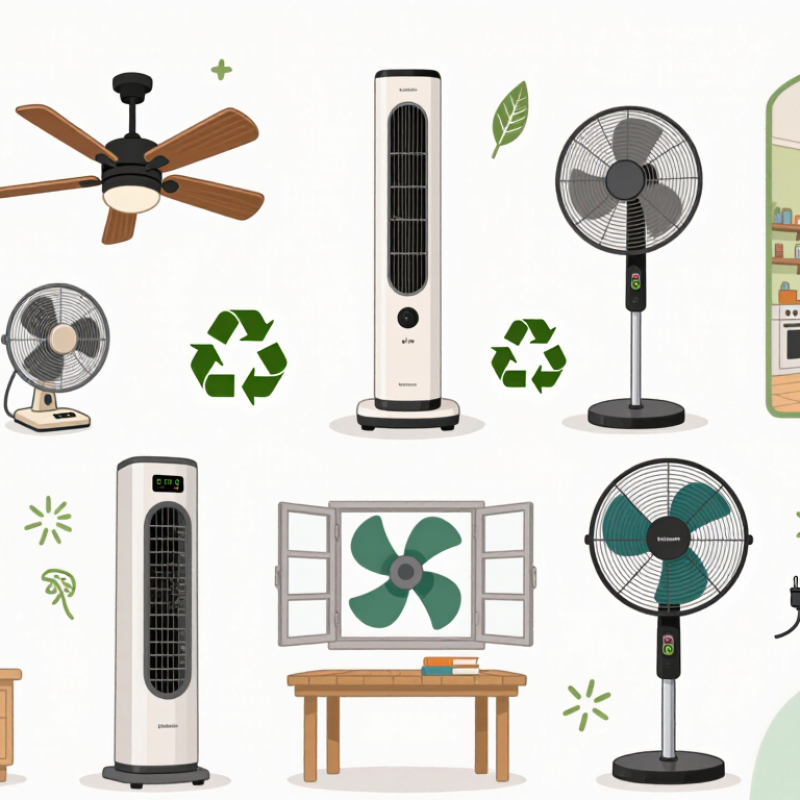
Efficient options include ceiling, tower, pedestal, desk, clip-on, wall-mounted, window, whole-house, DC-motor, and solar-assisted fans. A DC motor often uses less power than a traditional AC motor. Variable-speed controls also prevent unnecessary energy use. In a bedroom, a low setting may provide enough airflow through the night.

Small details matter. A clean grille and balanced blades reduce resistance and noise. Timers prevent an empty room from consuming power. Smart sensors can adjust speed, but their extra electronics may complicate repairs. That deserves attention. An efficient product is not automatically sustainable if it fails quickly or cannot be repaired.

Check the power rating before buying. A 35-watt fan running eight hours daily uses about 0.28 kilowatt-hours per day. Actual consumption changes with speed and operating time. Choose durable housing, replaceable parts, and recyclable materials where possible. Open windows when outdoor air is cooler, then use the fan to circulate it. This simple habit can reduce both energy demand and household emissions.
Ten Main Types of Environmentally Friendly Fans for Buyers

Ten Main Types of Environmentally Friendly Fans for Buyers

Environmentally friendly fans can reduce cooling energy, but no single design suits every room. Ceiling fans circulate air across large spaces and work well with moderate thermostat settings. Tower fans use compact motors and fit narrow bedrooms. Pedestal fans provide adjustable height and strong airflow for workshops or living areas. Table fans suit desks, bedside tables, and small personal zones. Wall-mounted fans save floor space and direct air toward busy areas.

Window fans can pull in cooler outdoor air or exhaust warm indoor air. Whole-house fans move evening air through the building, but they need suitable attic ventilation. Exhaust fans remove moisture from kitchens and bathrooms, protecting walls from long-term dampness. Solar-powered fans can operate away from the grid, although cloudy weather may reduce performance. Evaporative cooling fans add moisture while cooling air, making them more useful in dry climates than humid ones. That difference matters.

Tips: Check the energy label, airflow rating, noise level, and motor controls. Choose the smallest fan that meets the room’s needs. Clean grilles and blades monthly, because dust restricts airflow and increases strain. A timer or temperature sensor can prevent unnecessary operation. Measure the window or wall area before buying. Solar models may need battery storage. Evaporative models also consume water, which some buyers overlook. Personal testing remains valuable; a quiet fan with weaker airflow may be better for sleep than a powerful, distracting model.

Top 10 Types of Environmentally Friendly Fans for Buyers

Typical rated power comparison for energy-conscious fan choices. Lower wattage generally means lower electricity use when airflow and operating time are comparable. Values represent common product specifications by fan type, not any specific brand.

How to read the chart: A fan rated at 50 W uses approximately 0.05 kWh for every hour of operation. Actual consumption depends on speed settings, airflow, motor efficiency, and operating time.

Key Features That Determine a Fan’s Sustainability

Top 10 Types of Environmentally Friendly Fans for Buyers

Key Features That Determine a Fan’s Sustainability

An environmentally friendly fan should use less electricity without sacrificing useful airflow. Energy consumption matters across ceiling, tower, pedestal, desk, wall-mounted, window, box, clip-on, bladeless, and solar-powered models. Check the wattage label, but do not judge efficiency from wattage alone. A smaller fan may consume less power yet cool one person poorly, causing longer operating hours.

A strong motor with several speed settings usually provides better control. Brushless motors can reduce friction, noise, and maintenance needs. Timers, temperature sensors, and automatic shutoff features prevent unnecessary running. I have found that a low-speed setting often feels comfortable at night, especially with a stable airflow pattern. Still, “smart” controls can add electronic parts and shorten repairability if they fail.

Materials also shape a fan’s environmental impact. Look for durable housing, replaceable filters, accessible screws, and clearly available spare parts. Recycled plastic is helpful, but durability matters more when the product is discarded quickly. A repairable ceiling or pedestal fan may outlast several cheap desk fans. Packaging should use limited plastic and recyclable cardboard. Solar or rechargeable fans can help during power interruptions, yet battery replacement remains a concern. That detail is easy to overlook. Check battery specifications, charging life, and safe recycling instructions before buying. Quiet operation, stable construction, and washable components improve daily use, although personal comfort still varies.

How to Compare Efficiency, Performance, and Operating Costs

When comparing the top 10 environmentally friendly fan types, efficiency must come before appearance. The list includes ceiling, tower, pedestal, desk, box, window, exhaust, whole-house, high-volume low-speed, and evaporative fans. Each suits a different room and airflow target. The International Energy Agency reports that space cooling uses about 10% of global electricity. Small efficiency gains matter.

Check the motor rating, airflow, noise, controls, and standby demand. A higher wattage does not always mean stronger performance. Compare cubic metres per minute, or cubic feet per minute, against watts. A practical measure is airflow efficiency: divide airflow by electrical input. Variable-speed motors often reduce output smoothly, unlike basic three-speed models. The U.S. Department of Energy notes that ceiling fans can support a thermostat setting about 4°F higher, but only when people feel the moving air. They do not cool an empty room. That detail is easy to miss.

Tips: Measure the room first. Use a timer. Clean blades and grilles monthly. For operating cost, multiply watts by daily hours and your local electricity rate. A 40-watt fan running eight hours daily uses about 9.6 kilowatt-hours monthly. Check independent test data, not only packaging claims. In my experience, the quietest model is not always the most efficient. Airflow readings can also vary between laboratories, so comparisons remain imperfect. Research from the U.S. Energy Information Administration shows residential electricity prices differ widely by region, making local tariffs essential for honest cost estimates.

Top 10 Types of Environmentally Friendly Fans for Buyers - How to Compare Efficiency, Performance, and Operating Costs

Rank Fan Type Typical Electrical Input Typical Airflow Indicative Airflow Efficiency Typical Sound Level Estimated Annual Electricity Cost Best Use Environmental and Buying Considerations
1 Brushless DC Ceiling Fan 15–35 W 2,000–6,000 CFM Approximately 60–400 CFM/W 25–45 dBA US$3.46–$8.06 Large living rooms, bedrooms, offices, and covered outdoor areas Very low energy use and efficient speed control. Select models with replaceable controls and recyclable metal components where available.
2 High-Volume, Low-Speed (HVLS) Fan 150–1,500 W 20,000–100,000 CFM Approximately 70–670 CFM/W 35–65 dBA US$34.56–$345.60 Warehouses, workshops, gyms, agricultural buildings, and large commercial spaces Moves a large volume of air at low speed and can reduce dependence on mechanical cooling. Efficiency depends heavily on ceiling height, blade diameter, and controls.
3 Brushless DC Pedestal Fan 15–40 W 1,500–4,500 CFM Approximately 40–300 CFM/W 30–55 dBA US$3.46–$9.22 Personal cooling, bedrooms, home offices, and temporary work areas Low power demand, adjustable airflow, and good portability. A timer or occupancy sensor can prevent unnecessary operation.
4 Electronically Commutated (EC) Box Fan 25–70 W 1,500–4,000 CFM Approximately 20–160 CFM/W 45–70 dBA US$5.76–$16.13 Garages, workshops, utility rooms, and general air circulation EC motors maintain efficient operation over a broad speed range. Choose a washable grille and a durable motor housing to extend service life.
5 Brushless DC Tower Fan 20–45 W 500–2,500 CFM Approximately 15–125 CFM/W 35–55 dBA US$4.61–$10.37 Bedrooms, apartments, and spaces with limited floor area Compact and efficient at low speeds. Check whether the filter, control board, and oscillation mechanism can be serviced rather than replacing the entire unit.
6 Reversible Window Fan with Electronic Controls 35–80 W 1,500–4,000 CFM Approximately 20–115 CFM/W 45–70 dBA US$8.06–$18.43 Cross-ventilation, kitchens, workshops, and mild-weather cooling Can exhaust warm indoor air and draw in cooler outdoor air, reducing air-conditioning demand when outdoor conditions are suitable. Use only when outdoor air quality is acceptable.
7 High-Efficiency AC Ceiling Fan 50–90 W 2,500–6,000 CFM Approximately 30–120 CFM/W 30–50 dBA US$11.52–$20.74 Residential rooms where low initial cost and simple controls are priorities Typically consumes more electricity than comparable DC models but can provide long service life and simple repairability. Use a wall control or timer to limit runtime.
8 EC Whole-House Fan 200–700 W 3,000–7,000 CFM Approximately 5–35 CFM/W 45–65 dBA US$46.08–$161.28 Whole-home ventilation and nighttime cooling in suitable climates Can replace or reduce air-conditioner use during cool evenings. Proper attic ventilation, insulated dampers, and appropriate climate conditions are important for performance.
9 Energy-Efficient Bathroom Exhaust Fan 10–40 W 50–150 CFM Approximately 2–15 CFM/W 20–40 sones-equivalent quiet range US$2.30–$9.22 Bathrooms, laundry rooms, and moisture-control applications Helps prevent mold and moisture damage. Humidity sensors and run-on timers improve ventilation while avoiding excessive operating time.
10 EC Destratification or Industrial Air-Circulation Fan 30–250 W 2,000–20,000 CFM Approximately 80–670 CFM/W 35–65 dBA US$6.91–$57.60 High-ceiling buildings, retail spaces, workshops, and light industrial areas Redistributes warm air that collects near ceilings and may reduce heating losses. Select variable-speed controls and size the unit for the actual floor area and ceiling height.

How to interpret the figures: The values are typical market ranges for comparable fan categories, not guaranteed ratings for every model. Airflow depends on blade size, speed, installation, and system resistance.

Annual cost assumption: Estimated using 8 hours of operation per day, 180 days per year, an electricity rate of US$0.16 per kWh, and the stated input-power range. Actual costs vary by local electricity prices, runtime, and control settings.

Efficiency comparison: Higher CFM/W generally indicates more air moved per unit of electricity, but buyers should also consider noise, required airflow, room size, maintenance, controllability, and product service life.

Sound information: Sound levels are indicative ranges measured or reported under typical operating conditions. Testing methods and installation environments can produce different results.

Choosing the Right Eco-Friendly Fan for Different Spaces

Choosing the right eco-friendly fan starts with the room, not the product label. For bedrooms, a quiet ceiling or tower fan can move air gently across the bed. ENERGY STAR reports that certified ceiling fans may use about 60% less energy than conventional models. A desk fan suits a home office, while a wall-mounted model saves floor space in a small studio. Look for efficient motors, multiple speed settings, and a timer.

Kitchens and bathrooms need targeted airflow. Window fans can create cross-ventilation, while exhaust fans remove moisture and cooking odors. A box fan works well near an open window, but its seal may be poor. That detail matters. For large workshops or retail spaces, high-volume, low-speed fans distribute air with less noise than several small units. Pedestal fans are flexible for temporary cooling, although they can be easier to knock over.

Hot, dry rooms may benefit from an evaporative cooler, but humid climates reduce its value. The U.S. Department of Energy notes that fans cool people, not entire rooms, so switch them off when the space is empty. This is often ignored. Check airflow ratings, measured noise, standby power, and repairable parts before buying. The International Energy Agency identifies cooling as a major driver of electricity demand, making small efficiency choices relevant. I would still test airflow at sitting height; advertised coverage can feel optimistic in a furnished room.