China is a major manufacturing base, but scale alone does not identify the right supplier. Buyers comparing Industrial Fans should look beyond catalog prices and check airflow curves, motor efficiency, vibration limits, materials, and test records. The U.S. Department of Energy’s Improving Fan System Performance sourcebook reports that fans account for about 15% of electricity used by industrial motors in the United States. That figure is not China-specific, but it shows why operating efficiency deserves careful review.
For sourcing guidance, quality-management expert W. Edwards Deming offered a useful reminder: “In God we trust; all others must bring data.” Apply that principle to Chinese manufacturers. Ask for model-specific performance tests, factory quality procedures, sample inspection options, and clear warranty terms. Confirm whether a supplier designs and builds the fan or mainly resells it. Request references for installations with similar dust levels, temperatures, and duty cycles. A well-finished housing means little if the delivered unit misses its airflow target.
No checklist is perfect. A polished datasheet can still leave questions unanswered. This guide will help buyers compare factories, authorized distributors, and sourcing platforms, then narrow the field through verifiable evidence. The best choice is rarely the cheapest quotation. It is the supplier whose technical claims can be tested and whose support remains available after delivery.
Before comparing suppliers in China, define the conditions the fan must handle. Estimate the required airflow and static pressure, then note duct length, bends, filters, and outlet size. A dusty workshop, humid process area, and clean warehouse need different materials and protection. Record ambient temperature, available voltage, operating hours, and acceptable noise levels. Measure the installation space, too. A fan that moves enough air on paper may not fit the existing ductwork.
Tips: Share a simple layout, airflow target, and operating schedule with potential suppliers. Ask for performance data at your required pressure, not just a maximum airflow figure. Request details on motor power, materials, testing, and maintenance access. Small omissions matter.
Be realistic about uncertainty: early airflow estimates are often rough. If the system has several branches, ask a qualified engineer to review pressure losses before ordering. Compare supplier proposals against the same written specification, and clarify what each test result represents. Confirm dimensions, connection points, and included accessories on a drawing. Keep a little room for adjustment; site conditions rarely match every initial assumption.
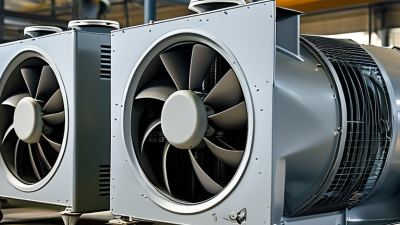
Industrial fan selection begins with the air path, not the catalog. Axial fans move large volumes through open spaces, making them useful for warehouses, workshops, and general ventilation. They perform best when resistance is low. Simple, but not universal.
Centrifugal fans suit systems with long ducts, filters, or process equipment that create higher pressure losses. Their blade design affects efficiency, noise, and maintenance needs. Mixed-flow fans sit between axial and centrifugal designs, offering compact airflow with moderate pressure for corridors or equipment rooms. For hot, dusty, or corrosive air, check materials, seals, and temperature ratings before comparing motor power.
When sourcing in China, share the operating point, air temperature, dust load, voltage, and duty cycle with shortlisted suppliers. Request a fan curve, measured sound data, and clear motor details; a polished brochure alone proves little. Ask how performance was tested, and confirm that the offered configuration matches the test sheet. Small discrepancies matter. A fan that looks right can still miss its airflow target after installation, especially when duct resistance was estimated too casually. Recheck the system assumptions.
To find industrial fan suppliers in China, search by application and manufacturing cluster, not just by product name. Compare suppliers that build axial, centrifugal, or high-temperature fans for similar operating conditions. China’s National Bureau of Statistics reported that manufacturing value added grew 6.1% in 2024. This indicates broad production capacity, not that any particular fan supplier is reliable. A useful filter: ask whether the company manufactures the fan in-house or mainly trades finished units.
Shortlist factories that can show a working test bench, impeller-balancing records, motor specifications, and traceable inspection reports. Ask for airflow, static pressure, noise, and efficiency data at stated operating points. ISO 5801:2017 provides standardized methods for testing industrial fan performance. Request the test conditions, not only a headline figure. Then compare samples and factory records against your duty requirements. I would not treat a polished catalog as proof; that shortcut is tempting, but weak. An on-site or live video audit can help confirm equipment and production steps, though it cannot replace independent testing.
Choosing a Chinese manufacturer requires more than comparing prices or browsing product photos. The U.S. Department of Energy’s Improving Fan System Performance sourcebook says fan systems can offer energy savings of 20–50% through targeted improvements. That range is potential, not a promise. Ask suppliers to state airflow, static pressure, power consumption, and operating conditions on the same quotation.
Request a performance curve and a recent test report for the exact fan model. Check that the reported duty point matches your process, not just the fan’s maximum airflow. Ask how the impeller is balanced and what materials are used for the casing, shaft, and coating. A small coating defect near a seam may matter in a humid plant. It is a detail worth checking.
The IEA’s Energy Efficiency 2018 report estimates that electric motor systems use about 45% of global electricity, making motor selection and control relevant to operating costs. Ask whether the motor’s rated efficiency and speed control options are documented. For shortlisted factories, request a live production-line video or arrange an independent inspection. I would still treat a polished showroom sample cautiously; it may not represent routine production. Compare serial traceability, warranty terms, spare-part availability, and the supplier’s response to technical questions.
Before ordering industrial fans from a Chinese supplier, match the fan to the actual duty point. Confirm required airflow, static pressure, air temperature, dust or moisture exposure, and operating hours. Ask for a performance curve showing the proposed operating point, not only a maximum airflow figure. Check the impeller material, motor rating, voltage, frequency, enclosure protection, noise level, and installation dimensions. Request the test method and a written tolerance for airflow and pressure. ISO 5801 provides standardized methods for testing industrial fans; comparable test conditions make supplier data easier to evaluate.
Energy use deserves attention. The U.S. Department of Energy’s 2014 United States Industrial Electric Motor Systems Market Opportunities Assessment estimates that motor-driven systems use about 68% of U.S. industrial electricity. That figure covers many types of equipment, not fans alone, but it shows why motor efficiency and control strategy matter. Ask for rated power, efficiency information, and whether speed control is compatible with the motor. Verify the sample nameplate against the quotation. Small mismatches matter.
Before paying a deposit, confirm the inspection plan, packaging, lead time, spare-parts availability, and warranty terms in writing. For a custom unit, approve a drawing with dimensions and connection points; a fan that performs well can still fail to fit the duct. Request inspection records tied to the order, and clarify who pays if results fall outside the agreed limits. A tidy spreadsheet can still miss a site detail. Check twice.