How to Select a Low Noise High Pressure Fan for Your Needs?
Selecting a Low Noise High-Pressure Fan for your unique requirements is essential. The right fan can enhance efficiency and comfort in various environments. Noise levels, airflow rates, and pressure capabilities are critical factors to consider. A high-quality fan should operate quietly while delivering superior performance.
When evaluating options, it's vital to understand specific needs. Different applications require varying airflow and pressure levels. For instance, industrial settings might prioritize raw power, while residential applications focus on noise reduction. Knowing your specific context informs a better choice.
Not all fans are created equal. Some may promise low noise but compromise on airflow performance. This trade-off can lead to dissatisfaction. Users should seek reliable data and expert opinions. Exploring user reviews and consulting professionals will help make an informed decision.
Understanding the Importance of Low Noise High Pressure Fans
When selecting a low noise high pressure fan, understanding its importance is crucial. These fans are essential in various industries, especially where air quality and noise levels matter. Many reports highlight that noise pollution can lead to health issues, affecting productivity and well-being. In fact, the World Health Organization states that prolonged exposure to noise can impair hearing and increase stress levels.
Consider the operating environment. Industrial areas may require fans capable of maintaining air quality without adding excessive noise. The Engineering Toolbox states that effective fans can operate with sound levels below 50 dB, making them suitable for sensitive applications. This balance of high pressure and low noise can significantly enhance user comfort and operational efficiency.
Tips: Always evaluate performance specifications. Look for designs that minimize turbulence, as this can contribute to noise. Regular maintenance is essential for preserving optimal performance. Even slight wear can impact efficiency and increase noise levels. Be aware that even high-quality fans may have limitations. Finding the right fan involves careful consideration of airflow, pressure, and noise levels. Ensure you choose based on your specific needs rather than general suggestions.
Noise Levels of High Pressure Fans
Key Specifications to Consider When Selecting a Fan
When selecting a low noise high pressure fan, several key specifications play a crucial role. The fan's airflow output, typically measured in cubic feet per minute (CFM), is vital. A high CFM indicates excellent airflow, essential for high-pressure applications. Additionally, static pressure, measured in inches of water gauge (WG), determines how efficiently the fan can overcome resistance in ducts or filters. Higher static pressure ratings usually signify better performance in challenging environments.
Noise levels are another critical factor. Measured in decibels (dB), lower values correlate to quieter operation. According to industry reports, fans operating below 50 dB are suitable for sensitive environments like hospitals or libraries. Understanding sound pressure level can help in finding the right balance between performance and noise reduction.
Tips: When assessing a fan's performance, consider its efficiency ratio, which indicates power consumption relative to airflow. A well-designed fan saves energy and reduces operational costs. Remember to factor in the fan's build material, as it can influence durability and performance under high pressures. Regular maintenance also impacts fan efficiency, so plan for routine checks.
Materials and Design Features for Noise Reduction
When selecting a low noise high pressure fan, materials and design greatly influence performance. Various studies indicate that fans constructed with high-quality composite materials tend to produce less noise. For example, fiberglass and advanced polymers can absorb sound better than metals. Composite blades offer rigidity while minimizing resonance, which is a common noise issue in fan operation.
In addition to materials, the design features play a vital role in noise reduction. Aerodynamic blade shapes, for instance, can significantly decrease turbulence and associated sound levels. Research from the American Society of Mechanical Engineers (ASME) shows that fans designed with optimized airflow paths are up to 30% quieter. Moreover, incorporating sound-dampening enclosures can further muffle sound emissions.
However, achieving low noise does come with trade-offs. Many manufacturers prioritize noise reduction, sometimes at the expense of airflow efficiency. This can lead to a scenario where the fan operates quietly but fails to meet the desired pressure output. Regular evaluations and adjustments are essential to maintain a balance between noise levels and performance.
Evaluating Performance Metrics: Airflow, Pressure, and Efficiency
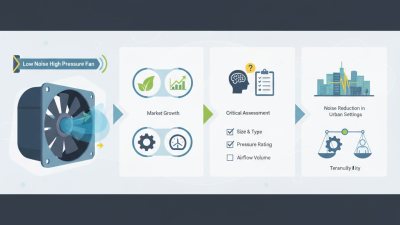
When selecting a low noise, high pressure fan, focus on three performance metrics: airflow, pressure, and efficiency. Airflow is measured in cubic feet per minute (CFM). Higher CFM values mean better air circulation. It’s crucial to assess how airflow fits your space needs. For instance, a larger area requires a fan with a higher CFM. However, balance is key. Overly powerful fans may create excess noise and energy waste.
Pressure is another vital metric. It refers to how effectively the fan pushes air against resistance. High-pressure fans are ideal for systems with filters or ductwork. However, picking a fan with excessive pressure capability can result in energy inefficiency. Understanding the specific requirements of your environment aids in making better choices.
Efficiency ties directly to energy consumption. Look for fans with good energy ratings, as this reflects their performance over time. While it may seem tempting to prioritize noise levels, don’t overlook efficiency. A quieter model could use more energy. Reflect on your actual needs. Sometimes, the ideal fan isn't just about low noise; it’s about finding a balance between noise, airflow, and pressure.
How to Select a Low Noise High Pressure Fan for Your Needs? - Evaluating Performance Metrics: Airflow, Pressure, and Efficiency
| Fan Model |
Airflow (CFM) |
Static Pressure (in H2O) |
Efficiency (CFM/Watt) |
Noise Level (dB) |
| Model A |
150 |
1.5 |
2.5 |
45 |
| Model B |
200 |
1.8 |
3.0 |
50 |
| Model C |
250 |
2.0 |
4.0 |
55 |
| Model D |
300 |
2.5 |
5.0 |
60 |
Application-Specific Considerations for Fan Selection
Selecting a low noise high pressure fan involves understanding specific applications. Each application requires unique characteristics. For instance, fans in HVAC systems need to balance airflow and noise levels effectively. Operating close to residential areas or quiet environments? Low noise design becomes essential to reduce disturbances.
Different applications influence fan specifications. Medical facilities demand ultra-quiet fans for sensitive environments. Industrial settings may prioritize high pressure for machinery cooling. However, high-performance fans can generate noise; achieving a balance is tough. It’s crucial to assess the environment and application to make a smart choice.
Always consider energy efficiency too. The operational costs can add up significantly over time. Selecting a fan that uses less energy may not always be straightforward. Sometimes, the most powerful fan doesn’t mean it's the best fit. Each project requires thorough evaluation and potential recalibrations based on noise assessments and operational needs. This process can be enlightening yet challenging.