How to Choose a Low Noise High Pressure Fan for Efficient Airflow?
Choosing the right cooling equipment can significantly impact efficiency in various industries. A Low Noise High-Pressure Fan is critical for maintaining proper airflow. According to a market analysis by Frost & Sullivan, the demand for such fans is projected to grow by 15% annually as industries seek solutions to reduce noise pollution while enhancing performance.
Dr. Emily Zhang, an expert in HVAC systems, emphasizes, "Investing in a Low Noise High-Pressure Fan can lead to substantial energy savings and a more comfortable environment." Such fans work efficiently under high pressure, providing optimal airflow without excessive noise. However, selecting the right fan is not straightforward. The specifications can be overwhelming, and many overlook essential factors like airflow volume and pressure rating.
In a world increasingly focused on sustainability, these fans can help mitigate noise pollution in urban settings. Yet, companies must critically assess their specific needs. Reflection on what size, type, and brand of fan is truly necessary could make all the difference in achieving the desired balance of performance and tranquility.

Understanding Low Noise High Pressure Fans and Their Importance
Low noise high pressure fans are essential for many applications. They provide efficient airflow without the disturbing noise typical of standard fans. These fans are designed to operate quietly while delivering a significant amount of airflow. This combination is particularly valuable in environments where noise control is crucial, such as offices or libraries.
Choosing the right fan involves several factors. The fan's design must ensure high static pressure, which allows it to overcome resistance in ducts. Many users overlook the importance of fan blade design. Curved blades can improve airflow efficiency while minimizing noise. It's also vital to consider the materials used in the fan construction. Some materials tend to vibrate more, creating unwanted sounds.
Reflecting on this, it's equally important to assess the installation and positioning of the fan. Even a well-designed fan can produce noise if improperly mounted. Users may need to experiment with different placements to find the quietest operation point. The balance between performance and noise levels requires careful evaluation. Ultimately, understanding the specifics of low noise high pressure fans can lead to better choices and improved airflow management.
Key Factors to Consider When Selecting a Fan for Efficient Airflow
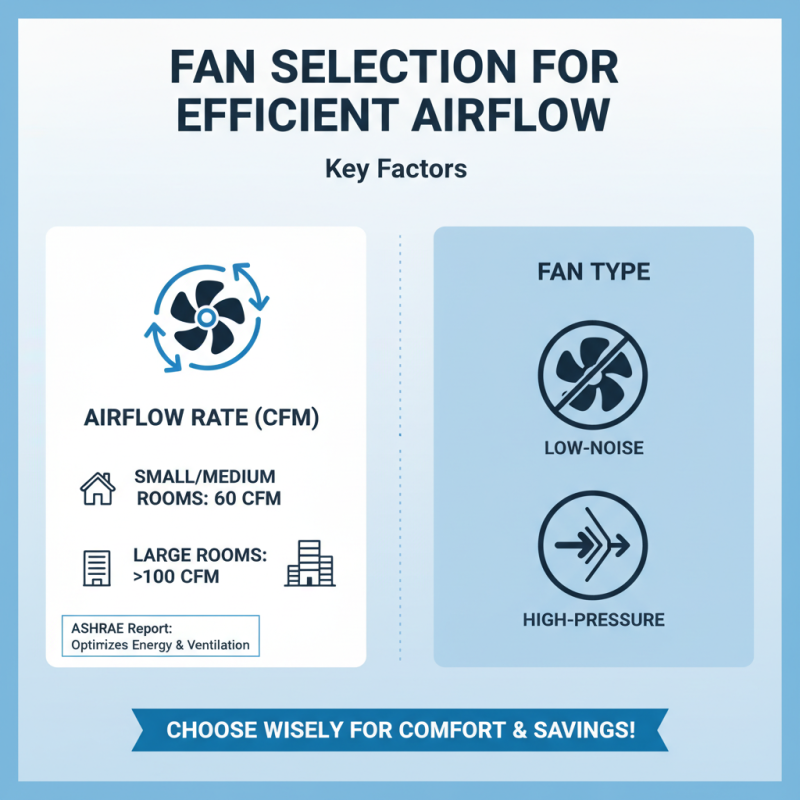
When selecting a low noise high pressure fan, several critical factors influence efficient airflow. One major consideration is the fan's airflow rate, typically measured in cubic feet per minute (CFM). A report by the American Society of Heating, Refrigerating and Air-Conditioning Engineers (ASHRAE) suggests that an optimal airflow rate can significantly reduce energy consumption and achieve desired ventilation levels. A fan that operates at 60 CFM can effectively serve small to medium spaces, while larger areas may require units exceeding 100 CFM.
Noise levels are another vital aspect. Many manufacturers provide decibel (dB) ratings to help consumers evaluate sound output. A quiet fan should produce under 45 dB, which is comparable to a library’s ambiance. However, real-world performance can differ. Users sometimes encounter noise levels higher than advertised. This discrepancy can stem from vibrations or installation issues. Therefore, checking user reviews can provide insight into actual performance.
Lastly, energy efficiency plays a significant role in construction and HVAC projects. Fans may display energy efficiency ratings (EER), indicating how well they convert energy into airflow. A well-designed high-pressure fan can achieve an EER of 3.5 or more. This metric helps in reducing operational costs. Yet, many overlook the long-term savings. Balancing initial costs with future efficiency is crucial. Collectively, these factors outline a comprehensive approach to selecting the right fan for your needs.
Evaluating Noise Levels: Measuring Decibels in Fan Selection
When selecting a low noise high pressure fan, it's crucial to evaluate the noise levels carefully. Noise levels are typically measured in decibels (dB). The acceptable range for most environments is below 60 dB. For instance, normal conversation ranges from 60-70 dB. Therefore, a fan operating at 50 dB will create a much quieter atmosphere.
A report by the American Society of Heating, Refrigerating and Air-Conditioning Engineers (ASHRAE) suggests that fans should ideally operate below 55 dB for residential areas. This level minimizes disruptions while ensuring efficient airflow. It is essential to consider not just the operational noise. The installation and surrounding surfaces can amplify sound, resulting in unexpected levels.
One misconception is that higher pressure fans are always noisier. In fact, modern designs focus on maximizing airflow at lower noise levels. However, poor installation can lead to unwanted vibrations. These vibrations can increase dB levels significantly. Understanding the specifics of your environment is vital for an effective setup. Always prioritize a fan's performance and noise efficiency. And remember, selecting the right fan involves more than just the dB rating. Attention to detail can make a noticeable difference.
How to Choose a Low Noise High Pressure Fan for Efficient Airflow?
| Fan Model |
Pressure (Pa) |
Airflow (m³/h) |
Noise Level (dB) |
Power Consumption (W) |
| Model A |
1500 |
250 |
38 |
75 |
| Model B |
1200 |
300 |
36 |
70 |
| Model C |
1000 |
350 |
34 |
65 |
| Model D |
1800 |
280 |
40 |
80 |
Assessing Airflow Capacity and Pressure Ratings for Your Needs
When choosing a low noise high-pressure fan, understanding airflow capacity and pressure ratings is crucial. Start by assessing the airflow needs of your space. Measure the area to determine the volume of air needed. Fans are rated by cubic feet per minute (CFM). Higher CFM values indicate stronger airflow. But, consider your comfort—too much airflow can be disruptive.
Next, evaluate pressure ratings. The static pressure rating indicates how well the fan can push air through ducts or filters. A higher static pressure is essential for systems with longer ducts. Noise levels are another factor. A fan that meets airflow needs but is too loud may not be suitable. Aim for a balance between CFM, pressure, and noise level. All details matter.
Finally, look for adjustable settings. Some fans offer speed controls, which can help fine-tune performance. Remember, what works for one application might not fit another. Testing different configurations can lead to unexpected results. Don't rush the selection process. Each choice can impact airflow efficiency and comfort in your environment.
Airflow Capacity and Pressure Ratings Comparison
Comparing Different Fan Designs for Noise Reduction and Efficiency
Choosing the right fan design is crucial for reducing noise while maintaining airflow efficiency. Various fan designs include axial, centrifugal, and mixed flow. Each type has unique characteristics that impact their operational sound levels and performance metrics. According to a recent study by the American Society of Heating, Refrigerating and Air-Conditioning Engineers, axial fans provide excellent airflow but can often generate higher noise levels compared to centrifugal fans.
Noise reduction is achieved through innovative engineering solutions. For instance, the blade shape and materials can significantly affect noise output. A report by the European Centre for Medium-Range Weather Forecasts highlighted that fans with curved blades operate at lower decibel levels due to smoother airflow. However, more complex designs may lead to higher manufacturing costs, which is worth considering in budget planning.
Another factor is the fan's operational speed. Fans running at lower RPMs tend to produce less noise. The trade-off is often a reduction in airflow efficiency. A balance must be struck between noise control and airflow requirements. In some applications, compromising on speed might not be feasible. Careful evaluation of specific needs will guide this decision. Exploring different designs and understanding their pros and cons is essential for an optimal selection.